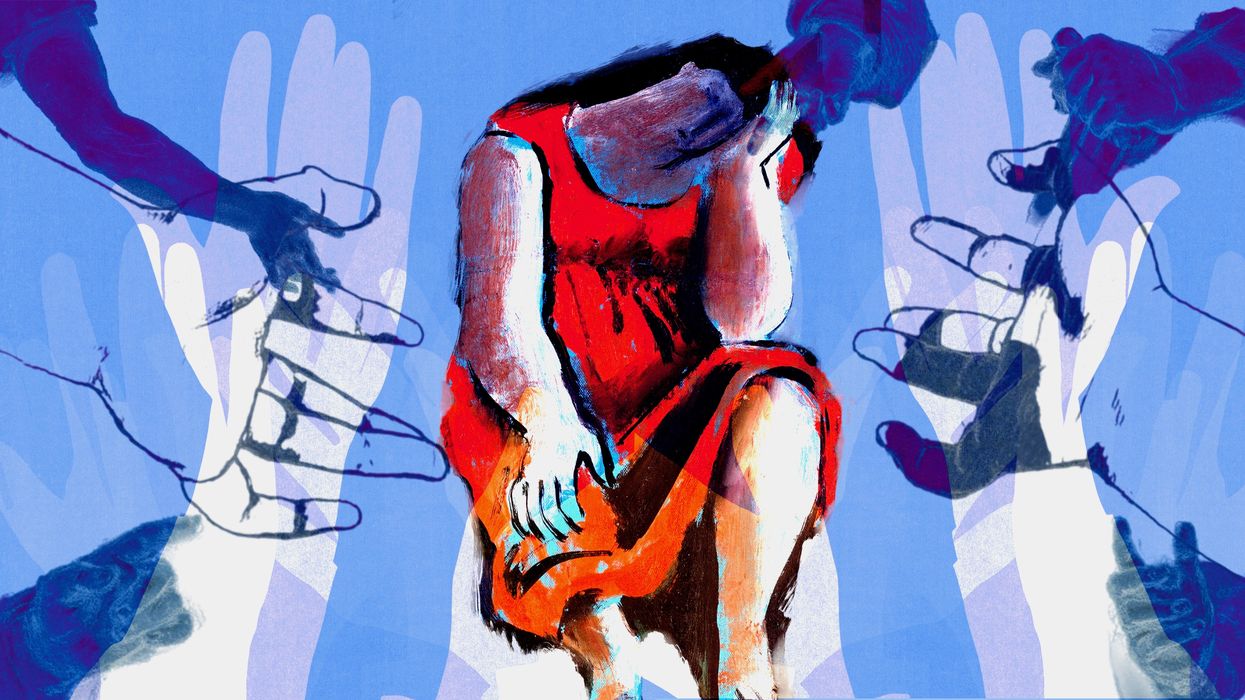



Courtney Stodden (she/they) has long been subject to other people’s narratives, with little opportunity to tell their own. At 16, they were thrust into the national spotlight, becoming front-page tabloid fodder as the teenage bride of then-51-year-old actor Doug Hutchinson. It was a media circus, complete with constant death threats, talk show punchlines and tweetstorms by vicious trolls. And beneath it all was the sexual objectification that forced them to embody a fantasy of femininity, feeling both on display and completely unseen.
However, Stodden’s been taking control over her life and the way it's perceived in the years since her 2020 divorce. As she’s come into her own, the actor, model and singer has become a vocal advocate against grooming, child abuse and cyberbullying while also being open about her struggles with mental health and gender identity. Now, in a new interview with VEXT, the star speaks about her evolving relationship with their body, decision to use she/they pronouns and the process of making peace with their past. Because after so many years feeling silenced, Stodden is finally at peace and ready to tell her own story.
Can you talk about the sexual objectification and accompanying scrutiny you faced while growing up?
I was basically thrown into a really adult world before I had the tools to even know who I was. At 16, the spotlight hit hard. The media obsessed over my body, my sexuality, my choices — things no teenager should be scrutinized for. It felt like I didn’t belong to myself. I belonged to the public’s opinion of me.
How did that all make you feel?
Isolated. Confused. I didn’t know if people liked me for me or just the image they’d built up. And when you’re constantly being told you’re too much, not enough, too sexy, not sexy the right way. It messes with your head. I felt like I was living in a costume someone else chose for me.
How has sexual objectification from a young age and being the public’s ultimate vision of femininity impacted your body image and self-esteem?
It made me second-guess every part of myself. I was trying to meet an impossible standard of “perfect femininity” that was never really mine to begin with. I was performing femininity for survival, not out of authenticity. It took years for me to realize that my body isn’t a product for public consumption. It’s mine, and I get to decide how I show up in it.
How has this impacted your mental health? What were some of the consequences and how did you deal with them?
The pressure definitely led to anxiety, depression and a lot of identity struggles. I had to unlearn the idea that my worth was tied to my appearance. Therapy saved me. So did journaling, getting into spiritual practices and surrounding myself with people who saw the real me. Not just the headline version.
Has the objectification gotten better or worse over time? Why do you think that’s the case?
It’s changed. I think being more open about who I am — especially coming out as nonbinary — has shifted the way people interact with me. Some people still don’t get it, and the objectification hasn’t magically disappeared, but now I have the power to name it, call it out and protect myself from it.
I am still in healing, and my self-confidence in my femininity is still transforming as I grow. [For example], she/her is not as scary as it was for me five years ago. So, I’ve taken the plunge and embraced my new pronouns with love and compassion for myself.
Did the sexual objectification change once you came out as nonbinary?
Oh, totally. People got confused, which, in a weird way, made them take a step back. The binary is so deeply ingrained in society that when someone steps outside of it, people don’t know how to label — or objectify — them as easily. There’s still fetishization and ignorance, but there’s also been space for me to claim a more fluid, honest version of myself.
How would you describe your current relationship to your body?
It’s honestly the healthiest it’s ever been. I’m not obsessed with meeting some outside standard anymore. My body is my home, not my enemy. I treat it with care. I dress for me. I move for joy, not punishment. There’s still work to do, but I’m finally in a place of compassion rather than criticism.
How did you get to a point where you feel more comfortable with your body?
Unlearning. A lot of it. I had to unlearn the idea that I existed to be “pretty” or desirable. I started focusing on what felt good instead of what looked good to others. Being open about my gender identity helped, too. It gave me permission to explore different expressions and discover what feels most like me.
Are there any issues that you still struggle with?
For sure. The voice of judgment doesn’t just disappear overnight. I still catch myself feeling triggered by messages or comparing myself to others. But now I can pause and ask myself, “Whose voice is that? Is that really my truth?” And more often than not, the answer is no.
What advice would you give other young femmes facing the same kind of scrutiny you have?
Your worth is not in how the world sees you, it’s in how you see yourself. Be loud about your boundaries. Find your truth and hold it close. You don’t owe the world a polished, perfect version of yourself. You owe yourself safety, love and the freedom to grow. And remember: there’s power in being soft, in being fluid, in being real. You’re enough just as you are. And most importantly, you do not owe anyone an answer.

![[10/10] La Chimera: A Dreamlike Descent Into Grief, Memory and Myth](https://vextmagazine.com/media-library/image.png?id=61454821&width=1245&height=700&quality=90&coordinates=0%2C0%2C1%2C0)